Gas monitoring signals
Portable detector readings can support alarm response, calibration planning, and incident review when the program defines sensor scope and ownership.

Connected safety is most useful when it supports a disciplined program instead of replacing one. Honeywell planning can connect portable gas detection, wearable alert concepts, training records, and category ownership into a workflow that helps EHS teams see what is happening and decide what to do next.
Discuss a Connected Safety Pilot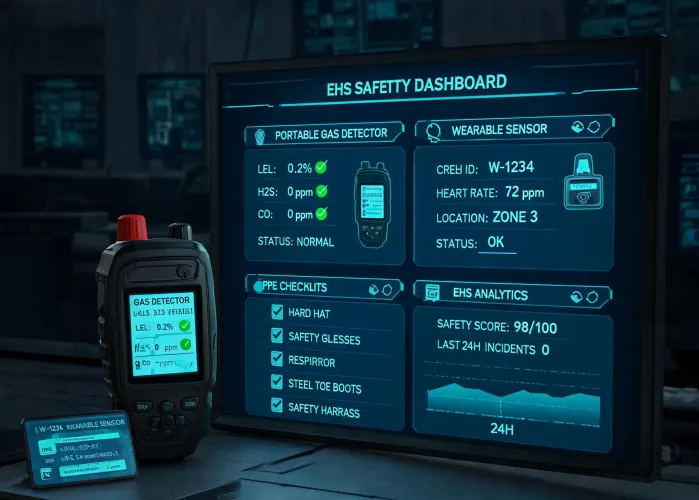
The platform concept is framed around operational decisions: what is monitored, who sees the alert, what evidence is retained, and how the purchasing catalog changes when the risk picture changes.
Portable detector readings can support alarm response, calibration planning, and incident review when the program defines sensor scope and ownership.
Wearable data can help pilot heat stress, lone worker, or proximity workflows where supervisors have a clear escalation path.
Dashboard views should separate leading indicators, action logs, and unresolved exceptions so data becomes program evidence.
Connected findings can inform PPE changes only when the standard reference and replacement rule stay visible.
Honeywell connected safety projects should start with a defined site, a defined hazard group, and a defined review cadence. The pilot can compare alarm routing, training response, detector service history, and PPE replacement rules before a wider rollout. This prevents dashboard enthusiasm from outrunning field procedures.
Choose the process area, detector families, users, and alert types.
Assign who reviews dashboards, documents actions, and closes exceptions.
Use the pilot to inform training, replacement, calibration, and category mapping.
Bring the use case, sensor scope, and stakeholders. We will help define a connected safety pilot that respects field procedures and compliance documentation.
Book a Pilot Review